
A game that began as money
Before there were tiles there were cards. The draw-and-discard card games played across China in the 1700s and 1800s used suits based on money. Probably around the middle of the 19th century, those cards were remade in bone and bamboo. The earliest sets we have come from the coastal cities of Fuzhou, Ningbo and Shanghai. The three suits kept their meaning, and they still have it.


Dots
Coins
Each circle is a copper coin, the kind with a square hole that English speakers called cash.


Bamboo
Strings of coins
Coins were carried threaded on a cord in their hundreds. Each stick is one string, and the suit’s Chinese name, 索, means string. Bamboo is what English players called them in the 1920s.


Characters
Tens of thousands
The lower character, 萬, means ten thousand, a pile of strings. The numeral above it counts how many.
So a hand of mahjong is, underneath, a hand of small change, purses and fortunes. Everything else on the tiles arrived later.
The oldest sets we have
The earliest tiles that survive date from about 1870. George Glover, an American working for the Chinese customs service in Fuzhou, collected two sets in the early 1870s. Both are now in museums in New York. They have the three suits and the four winds. They also have tiles that later vanished. One group was a family of eight rulers, including heaven, earth and the four directions. And they have no green dragon at all.
In a letter of 1875 Glover gave one set a name that includes the character for sparrow. That is the earliest record yet found of the sparrow in the game’s name, and the name stuck. In Cantonese the game is still 麻雀, the sparrow.
- 1870sThe earliest sets that survive are collected in Fuzhou, Shanghai and Ningbo. Suits and winds are there. The dragons are not yet the three we know.
- 1875George Glover writes down a name for the game that includes the sparrow.
- By 1890The green dragon has appeared.
- 1920Joseph Park Babcock publishes his Rules of Mah-Jongg. Sets for export gain numbers and letters in the corners, and go on sale in New York.
- 1923The craze peaks in America, Britain and France.
- 1930sSets made in the West turn to moulded plastics, among them the catalin that aged to butterscotch.
- 1937The National Mah Jongg League is founded in New York and starts to reshape the American set.
- 1960The League’s card for 1960 to 1961 is the first to require jokers, though some makers had put them in sets before.
- 1980s onMachines take over from hand carving in Hong Kong.
- 2014Hong Kong lists mahjong tile making as intangible cultural heritage.
Why the first Bamboo is a bird
On the earliest tiles the One of Strings is what you’d expect, a single string of cash. At some point carvers began to draw it as a bird, and nobody recorded why. A common suggestion is that the bird echoes the game’s sparrow name, but no source from the time says so.
By the 1920s workshops were drawing birds of their own. Collectors have catalogued cranes in flight, long-tailed birds, a phoenix and one bird hovering over a globe. Chinese sets most often show a sparrow and Japanese sets a peacock. No rule says which it should be, and that is why this one tile has always been where a maker leaves a mark.
Winds, dragons and flowers
The four winds, East, South, West and North, are on the oldest sets. The dragons came in stages. The character now used for the red dragon, 中, meaning centre, was already there by about 1870. The green one, 發, is short for a phrase that means to get rich, and had joined by 1890. The white seems to have begun life as a spare blank. In Chinese they were never dragons. That name was coined in English in the 1920s.
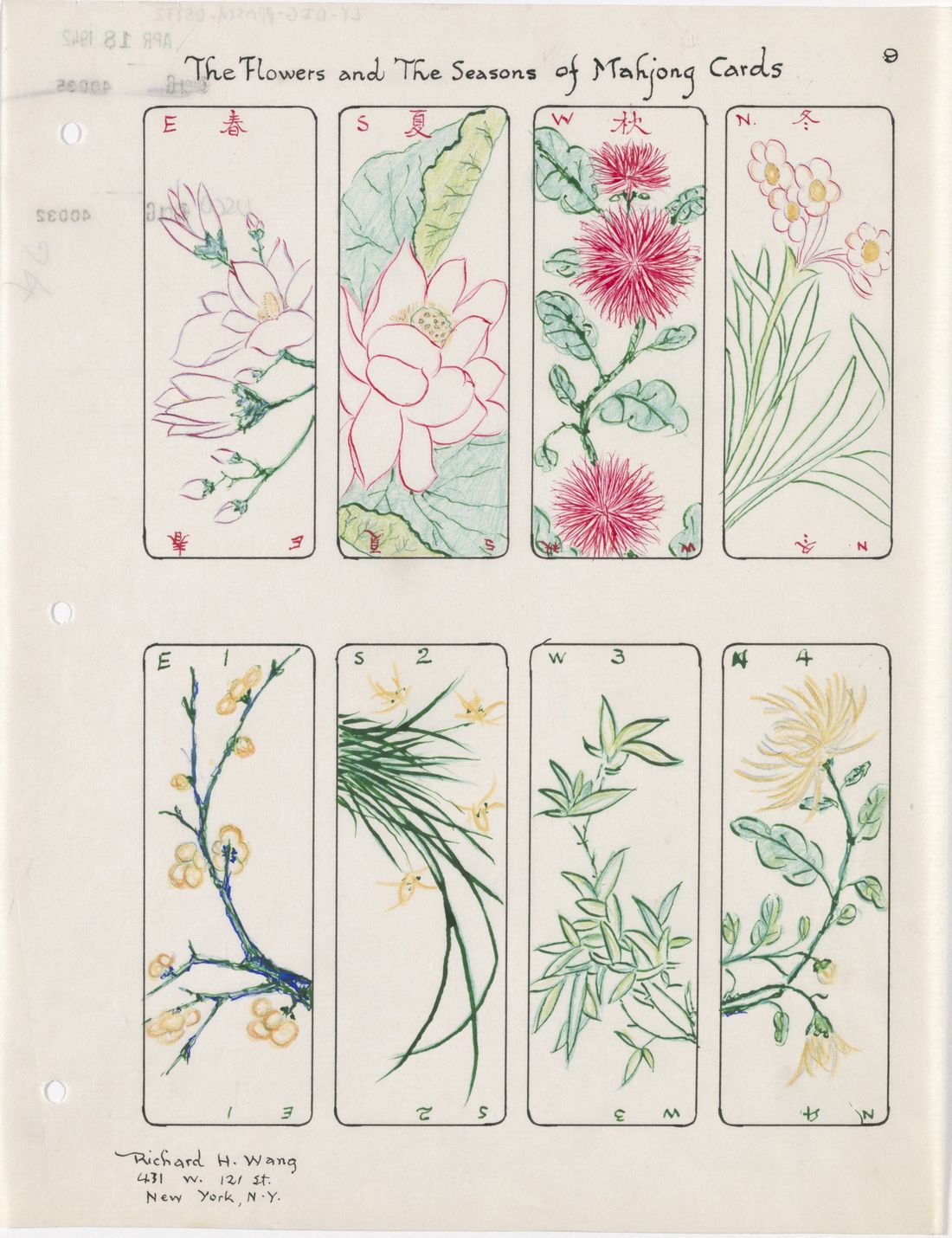
The flowers and seasons took longest to settle and weren’t universal until the 1920s. The usual eight are spring, summer, autumn and winter, and four plants, which are plum blossom, orchid, chrysanthemum and bamboo. They score as bonuses in most styles and are left out of others. They have always been the tiles where an artist had the most room.
1920 and the numbers in the corners
In 1912 an American engineer called Joseph Park Babcock was posted to Suzhou by Standard Oil. He learned the game there and simplified its rules for people at home. In 1920 he published them as Rules of Mah-Jongg, known from its cover as the red book. The sets made for export carried something new. Each tile had a small Western numeral or letter in its corner. Players who couldn’t read Chinese characters could then tell a three from an eight, and East from West.
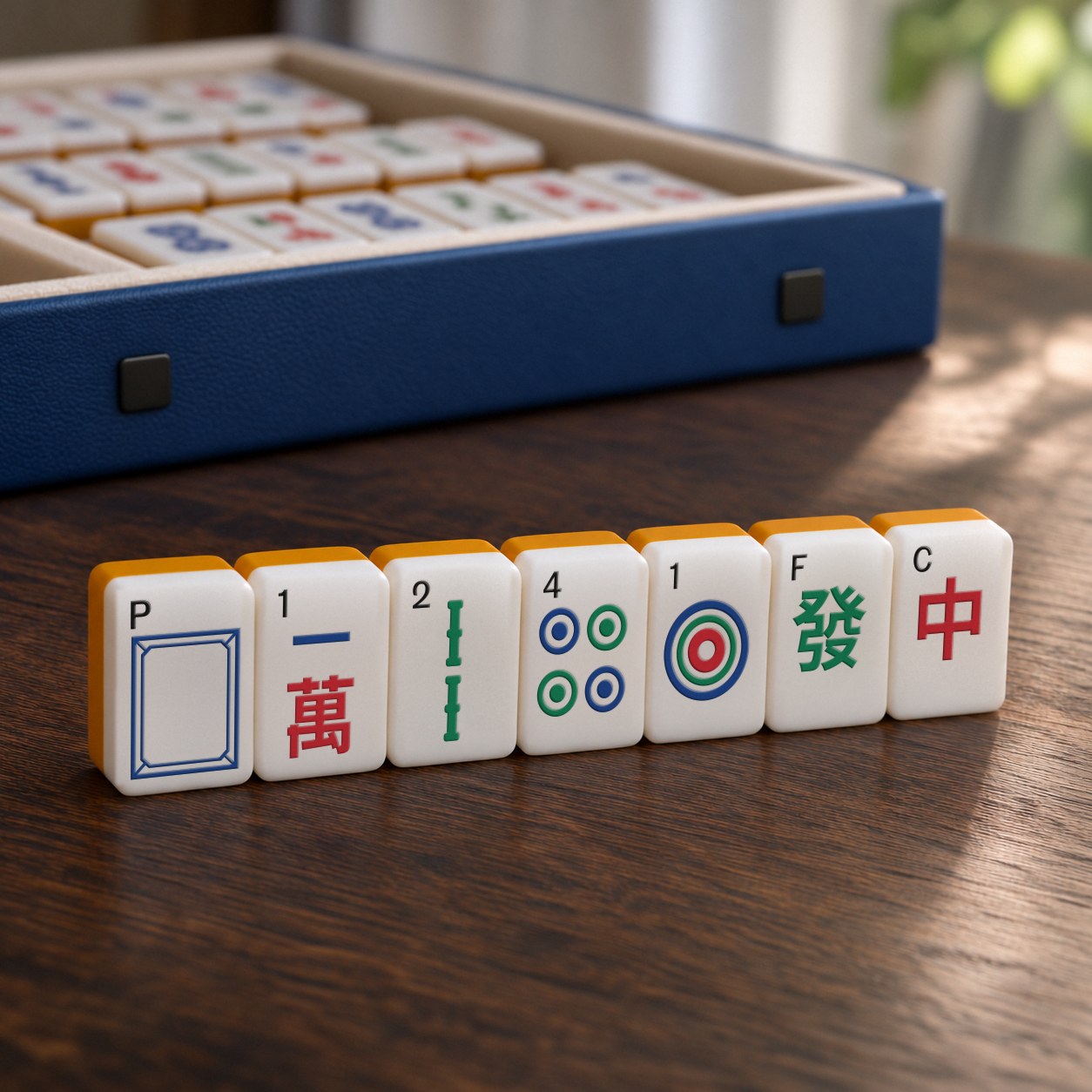
- The corner number The newest thing on the tile, added about 1920 for players who couldn’t read the characters. It helps while you learn and stays out of the way afterwards.
- 伍, five The numeral, here in its formal written form. The nine tiles of the suit count from one to nine.
- 萬, ten thousand The mark of the suit. A player of the 1920s would know this tile at a glance.
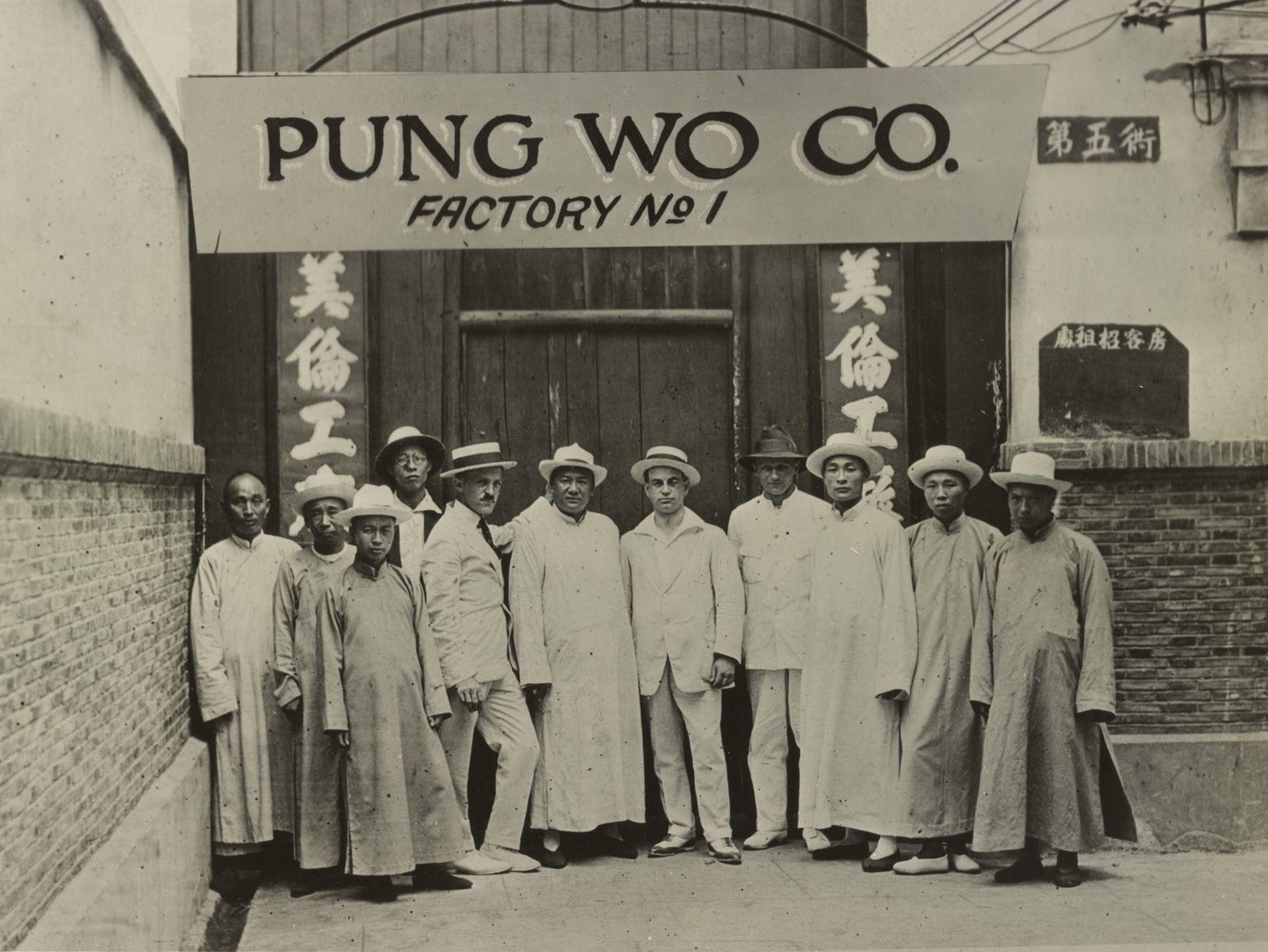
Abercrombie and Fitch put the first sets on sale in New York in 1920 and went on to sell 12,000. By 1923 the craze had reached Britain and France. Workshops around Shanghai turned to export. When local cattle bone ran short, shin bone came from the stockyards of Chicago and Kansas. It was cut, carved and painted in China.
New materials and new counts
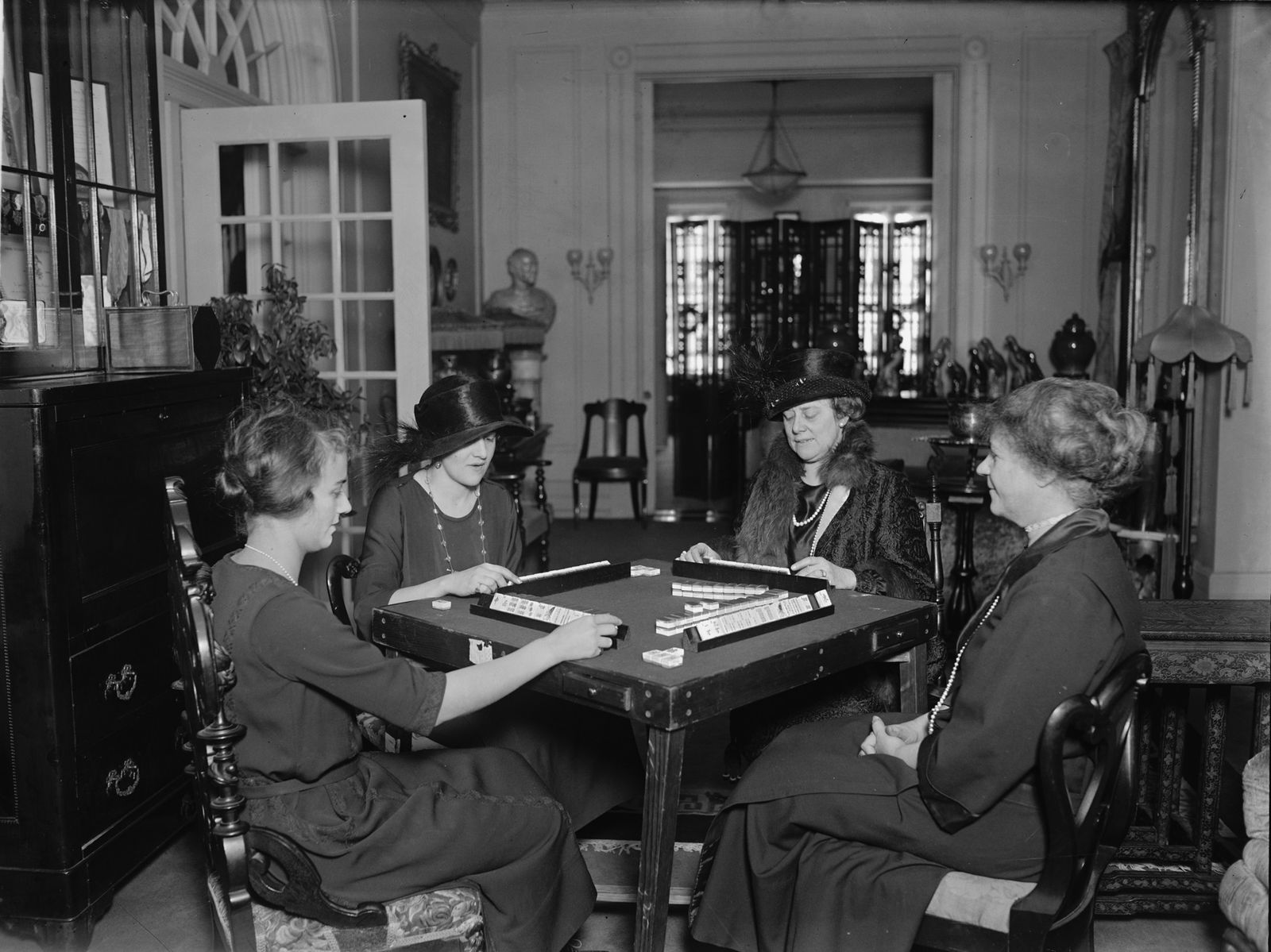
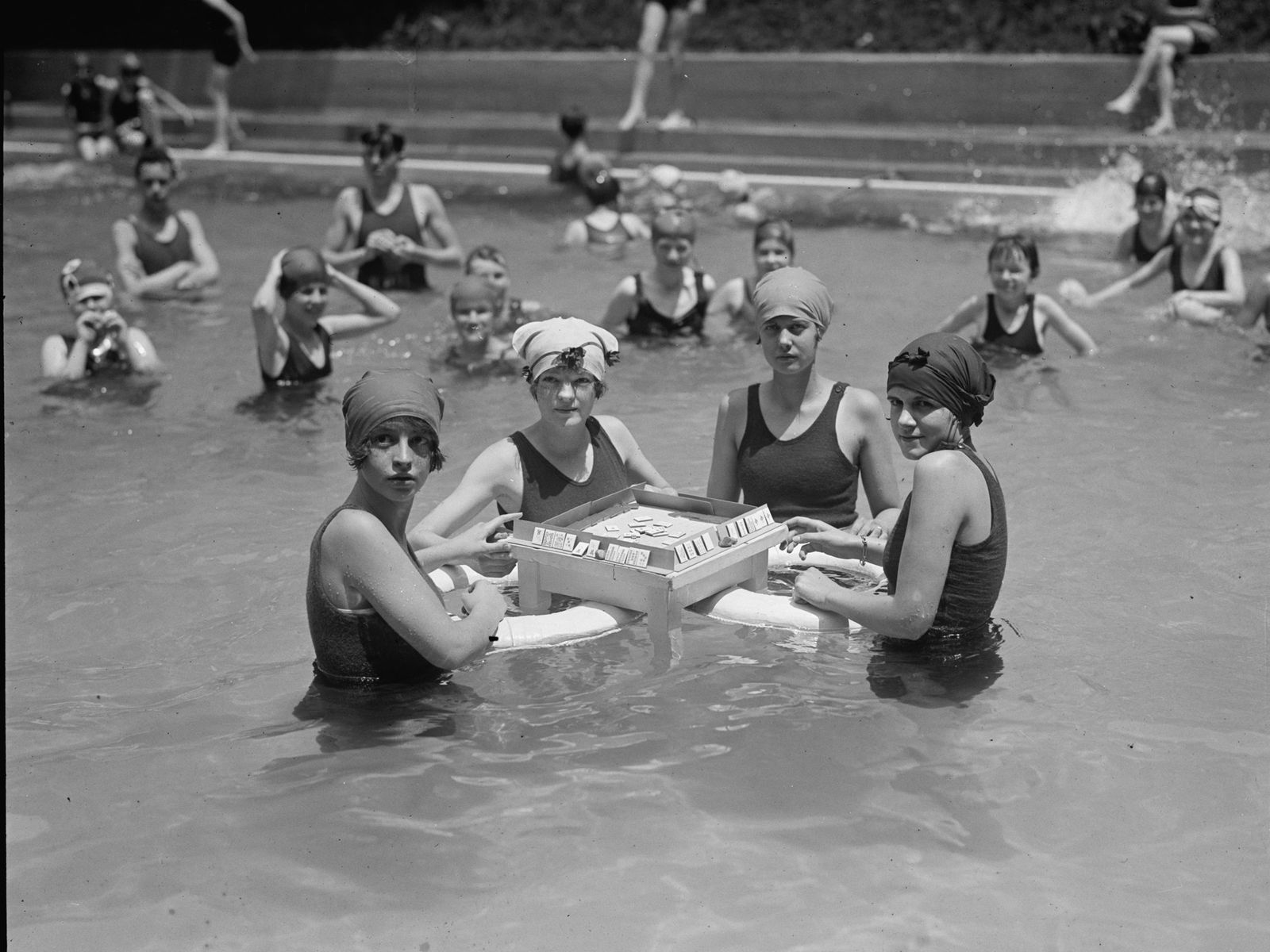
The craze had faded by the end of the 1920s and left importers with unsold stock. That’s why sets from those years are still easy to find. Makers in Europe and America had already begun to mould tiles from the new plastics. Germany made casein tiles, others used celluloid, and later came Bakelite and catalin. Catalin is the resin behind the butterscotch tiles of mid-century American sets.
The game then changed with its players. In America the National Mah Jongg League was founded in 1937. It began to issue a new card of winning hands each year. Its sets grew to carry as many as 24 flowers, until jokers replaced most of them. The card first required jokers for 1960 to 1961. Japanese players went the other way, dropping the flowers and later adding red fives. Singapore sets gained four animals. These later regional variations kept the standard 136 suit, wind and dragon tiles.
What survives of the craft
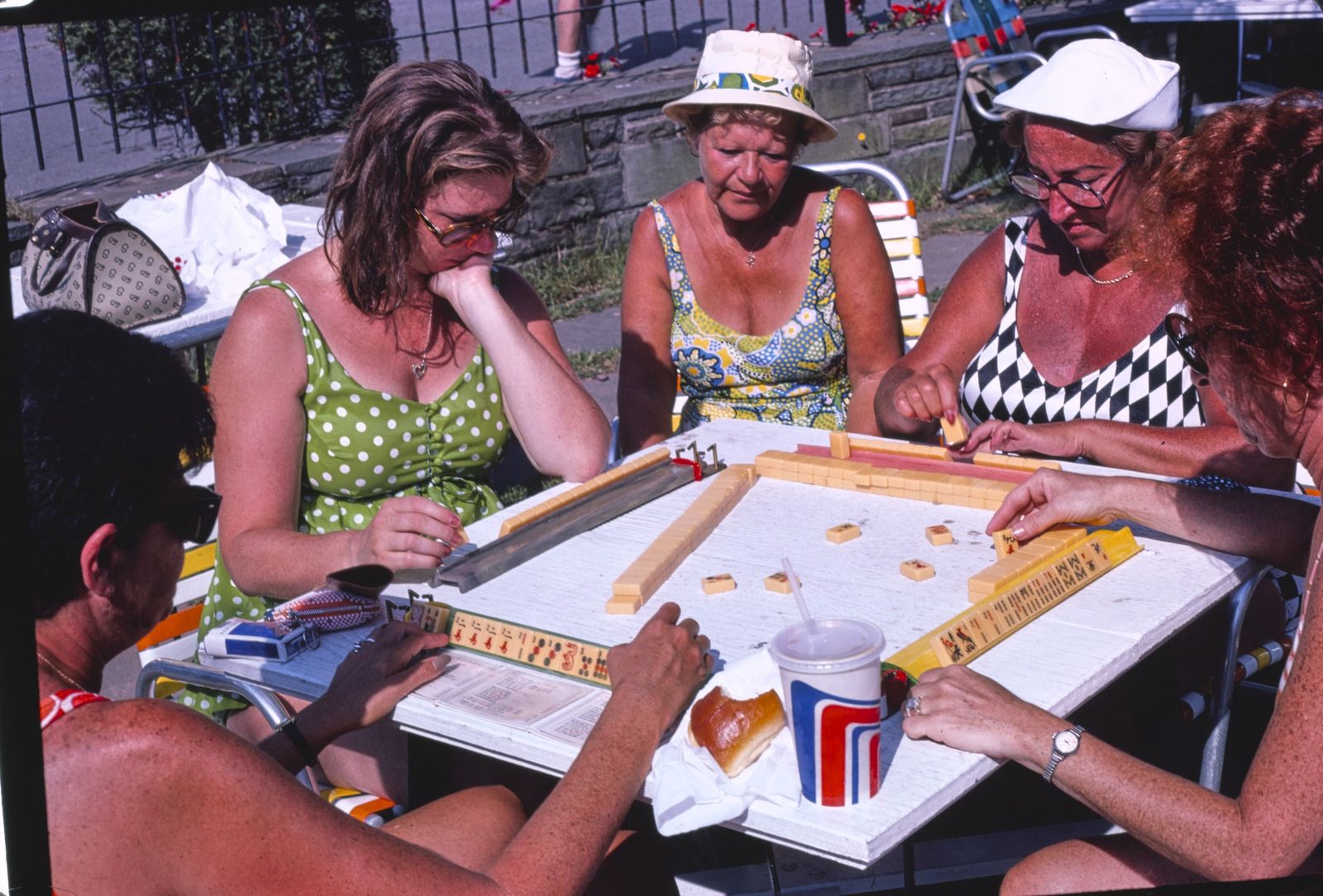
For most of the last century every tile was carved by hand. In Hong Kong, machines took over after the 1980s. Tables that shuffle and build the walls themselves followed in the late 1990s. In 2014 Hong Kong added mahjong tile making to its first list of intangible cultural heritage. Cheung Shun-king’s family at Biu Kee Mahjong has carved tiles for three generations. Cheung has told the South China Morning Post that fewer than ten people in Hong Kong still do the work.
What has barely changed in all that time is the face of the tile. A player from the 1920s could sit down at a table tonight and read every one.
What we kept, and the bird we added
When we designed our own set we treated all of this as the brief. The suits, winds and dragons are the game’s history, not ours to redesign, so the faces are the traditional ones. A Hong Kong mahjong teacher checks each one before it is engraved. Her first review changed eight of them. The corner numbers are there too, small, doing the job they were given in 1920.
The one place we’ve done what makers have always done is the first Bamboo. Ours is a sparrow, for 麻雀, drawn by Yennie Wong, a Hong Kong-born illustrator in London. The same bird flies across the lid of the case.

Read on
- How to play mahjongEvery tile named, and a first game explained from your own seat.
- How to buy a vintage mahjong setWhat to check on a 1920s set, and a checker for what it can play.
- Our storyThe borrowed set this one started with.
Sources
- The earliest sets, the Glover letter and the money suits follow Michael Stanwick’s Mahjong(g) Before Mahjong(g) and Stanwick and Hongbing Xu’s From Cards to Tiles, both at The Mahjong Tile Set, with the bird tiles from that site’s galleries.
- Materials follow Tony Watson’s Tile Set Materials on the same site.
- Dates for the dragons, flowers and Babcock follow Wikipedia’s articles on mahjong tiles, mahjong and Joseph Park Babcock and the sources they cite, chiefly Andrew Lo and Stanwick.
- The 1920s trade is from Luke Honey’s Collecting 1920s mahjong sets in Homes and Antiques.
- American counts are from Tom Sloper’s table of flowers and jokers by year.
- Hong Kong’s carvers are from the South China Morning Post.
- For the American story in full, read Annelise Heinz’s Mahjong, A Chinese Game and the Making of Modern American Culture (2021).
- Photographs are from the Library of Congress, which records no known restrictions on their publication.
- Version 2, November 2026.
 Pre-production image
168 tiles for six styles, with deep-engraved faces and a hand-finished illustrated case. £249, free UK delivery.
See the set