
The host's job is smaller than it looks. This guide is for a UK kitchen table, with a mixed group who may have learned different rules, or none.
| The night at a glance | |
|---|---|
| People | 4 at a table. 5 or 6 can rotate in. 8 needs two sets |
| Table | About 75 cm square of clear, flat surface. A card table or any dining table |
| Time | One hand 10 to 20 minutes. One round of four hands about an hour. Allow two hours |
| Kit | A set, a cloth, something to score with, the house-rules card, a lamp that doesn't glare |
| Decide beforehand | Which style, the minimum to win, who pays on a discard |
| Food | Things you can eat with one hand. Nothing greasy near the tiles |
1. Pick the style before the night
This is the one decision that makes or breaks the evening. Mahjong has six common styles. Picture a table where one person learned Hong Kong rules from their gran, one plays Riichi at a club and two have never played. They'll spend the first hour arguing about chows. Choose for the room. If most people are new, play Hong Kong style. It has the fewest rules to learn first, and it's what our guide to a first game teaches. If your experienced player knows another style, let them run the rules for the night. Keep it simple for everyone else.
Say the style in the invitation. An invite that says "Hong Kong rules, no experience needed, I'll teach the first hand" puts beginners at ease. It also tells the Riichi player what to expect. Then write what you've agreed on a house-rules card and put it on the table. Minimum to win, the limit, who pays when someone wins on a discard. Those three settle most arguments before they start.
2. The table
You need a flat, clear surface about 75 cm square. The wall takes up most of it. With tiles around 32 mm tall, each side of the wall is about 42 cm. In front of the wall, each player needs room for 13 tiles stood on edge, which is about another 30 cm. A standard card table at 86 to 91 cm square is the classic answer. A rectangular dining table works if the clear area in the middle is square enough, so move the fruit bowl.
Round tables are fine up to about 110 cm across. Beyond that the reach to the far wall gets long and the person opposite is a long way off. If you have a 120 cm round table, play on it, but expect to lean. The table does not need to be square, the wall does.
Put a cloth down. Tiles on a bare wooden table are loud, and they slide. A plain tablecloth or a felt mat is enough. Mahjong mats come at 78 to 80 cm square, which matches the number above. A thick cloth does the same job for nothing.
Light from above and slightly behind each player, not from a single lamp at one end. Glossy tiles throw a reflection at whoever sits opposite the lamp. Matt faces don't, which is one reason to look for them when choosing a set.
3. What to have ready
- The set. Counted the night before, with the extras for your style ready and the rest set aside. American play uses 152, including eight jokers. Hong Kong, British and Chinese Official use 144, Singapore 148 and Riichi 136. Our set keeps the 24 extras in their own tray so you can lift them out as one.
- Dice and a wind marker. Both come in the box. A coin with a sticker works as a marker in an emergency.
- Something to keep score with. Scoring sticks or chips if the set has them, otherwise a pad and a pencil. Nobody needs money on the table.
- The house-rules card, filled in and where everyone can see it.
- A chair for a fifth. Somebody always turns up. See below for what to do with them.
- Drinks away from the wall. One knocked cup ends the hand and soaks the cloth.
4. The first twenty minutes
Before the night, send anyone new First Hand, our free guided game for complete beginners. In about eight minutes they play their first hand of mahjong, so they arrive knowing how a turn works.
Beginners decide in the first twenty minutes whether this is a game they can play. Get them touching tiles quickly. While the kettle boils, tip the tiles out and sort them into their groups together, on the cloth. Name the suits, find the 1 Bamboo bird, set the flowers aside. Five minutes, and everyone has handled every kind of tile.
Then deal one hand face up. No claims, no score. Each person draws and discards in turn and says out loud what they're trying to build. Stop when someone has four sets and a pair, and let everyone see it. That one hand teaches the shape of the game better than any explanation. After it, deal properly. The full first-evening plan is at the end of the guide to a first game.
If one experienced player is at the table, sit them to the left of the newest beginner. The beginner can only chow from the player on their left. So the experienced player's discards become the lesson, and with a lean they can see the beginner's hand.
5. Five or six people
Mahjong is a four-player game and there is no good version for five at one table. Two ways work.
Rotate. The fifth person sits out one hand and comes in for the next. They take the seat of whoever lost the last hand, or of whoever has played longest if nobody wants to leave. A hand is 10 to 20 minutes, so nobody waits long, and the person sitting out can make the tea. With six, two sit out and come in together.
Two tables. With seven or eight people and two sets, run two tables and swap one player between them each round. This is how clubs do it. One host can't teach two tables of beginners at once, so put the beginners together at one table and teach that one.
For three or more tables, or to make sure everyone plays with everyone, use the mahjong night planner. It seats every round for 5 to 32 players and gives you one link to send your guests.
6. How long to play for
A full game is four rounds, at least sixteen hands. That's three or four hours at a social pace, which is too long for a first night. Play the East round, four hands, and stop. That is about an hour. If everyone wants more, play the South round. Decide the stopping point before you start so the person losing isn't the one who has to ask.
Scoring on a first night is optional. Many hosts play the first evening for the win alone and bring in points the second time, once people know what a hand is. If you do score, keep a running total on paper and settle nothing. The card has a line for your limit, so one lucky hand doesn't end the night.
If the night goes well, somebody asks when the next one is. That is the case for a set that lives on the table and not at the back of a cupboard. Ours was designed to be left out, in a deep blue case with an illustrated sparrow across the lid.
7. The checklist
- Style chosen and in the invitation.
- House-rules card filled in. Minimum, limit, who pays.
- Tiles counted, extras set aside.
- Cloth on the table, 75 cm square clear.
- Lamp not glaring at anyone's seat.
- Dice, wind marker, score pad or sticks.
- Fifth chair.
- A stopping point. The East round and then see.
Questions people ask
How many people do you need for mahjong?
Four. Three-player versions exist, and two can practise, but the game is built for four hands and a wall of four sides. For a night, invite four and have a plan for five.
What size table do you need for mahjong?
About 75 cm square of clear surface for a set with 32 mm tiles. A card table or an ordinary dining table is fine. Round tables work up to about 110 cm across. The table doesn't need to be square, the wall does.
Do you need a mahjong mat?
No. A mat quietens the tiles and stops them sliding, and a thick tablecloth does both. Buy a mat if you play on a polished table every week.
How long does a mahjong night take?
Two hours covers a sort-through, a practice hand and the East round. A full four-round game is an afternoon.
What do you serve at a mahjong night?
Anything eaten with one hand and no sauce. Dumplings, crisps, cut fruit, nuts. Drinks go on a side table, not next to the wall.
Can children play?
From about eight, with the corner numbers to help and the face-up practice hand first. The sorting at the start is the best bit for them.
Sources
- Tile and wall measurements are from our own 168-tile set and the 32 mm tile size most multi-style sets use.
- Mat sizes are from UK retail listings in October 2026.
- Timings are from our own tables.
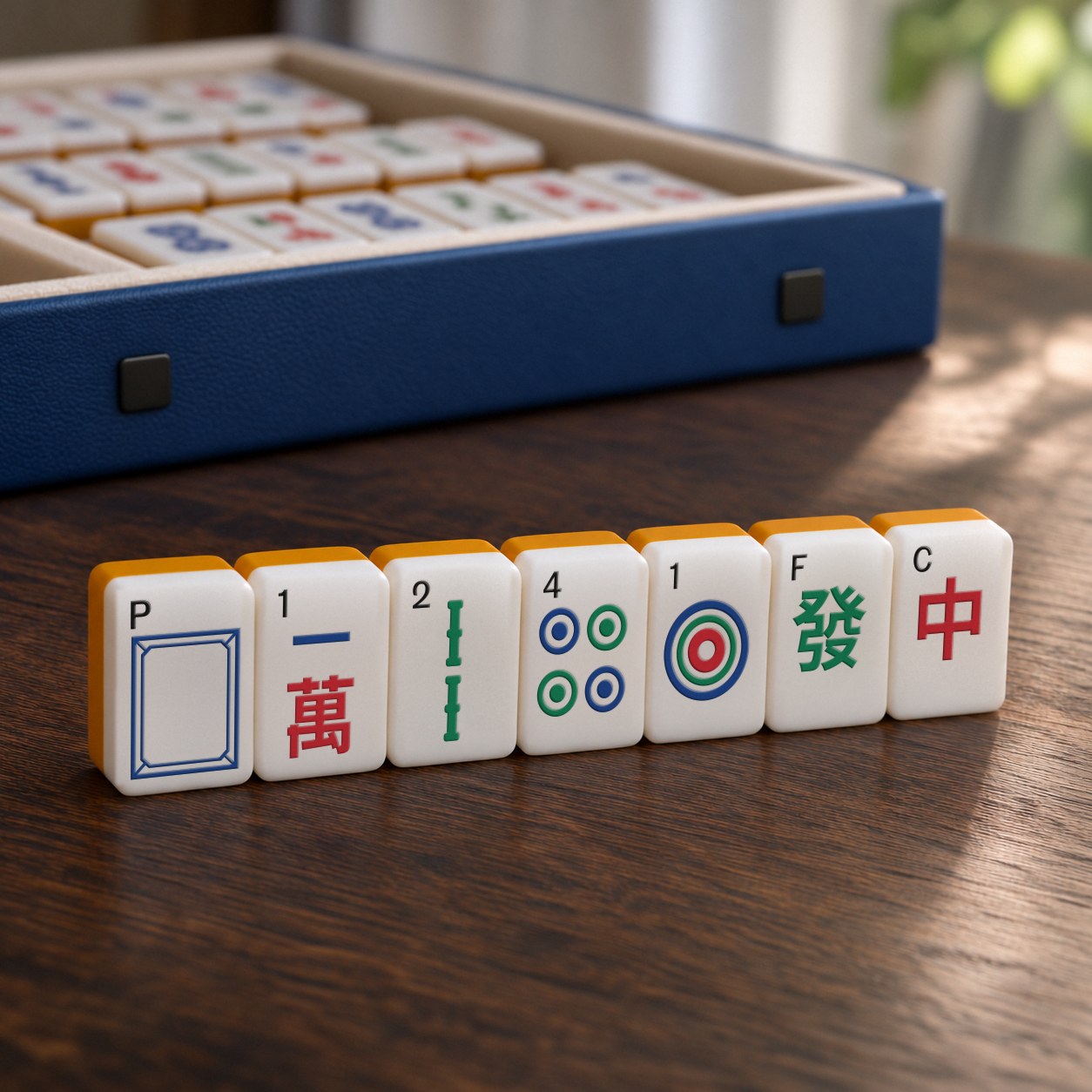 Pre-production image
168 tiles for six styles, with deep-engraved faces and a hand-finished illustrated case. £249, free UK delivery.
See the set