
You’ll hear it before you see it
Walk past a mahjong table and the first thing you notice is the sound. A hundred and forty-four tiles are being pushed round a table by eight hands. Players call it the clatter of sparrows. In Cantonese the game is written 麻雀, which means sparrow.
The game itself is simple to describe. Four people take turns to draw a tile and throw one away. In most styles each is trying to turn a hand of 13 tiles into four sets and a pair. If you’ve played rummy before, you already get the idea.
- 4 players, each for themselves.
- 144 tiles or so in the most common sets.
- 13 tiles in your hand.
- About 1870 the age of the oldest sets we have.
How it works, in under a minute
- Build the wall The tiles are shuffled face down and stacked into four walls, one in front of each player. This is where everyone draws from.
- Deal Each player takes 13 tiles and stands them up so only they can see them.
- Draw and discard On your turn you take one tile from the wall and throw one away, face up. You are always back to 13.
- Claim If someone discards a tile that finishes one of your sets, you can call for it, out of turn.
- Win The first player to complete four sets and a pair calls mahjong. Then the hand is scored and the tiles are shuffled again.


A winning hand. Two runs, two sets of three and a pair. Play a guided first turn.
What makes it worth learning
Mahjong sits between cards and chess. There is luck in every draw, so a beginner can win a hand on the first evening. There is skill in every discard, so a good player wins over a night.
It’s also a game you play with your hands. You shuffle, stack, draw and click tiles down. Nobody looks at a phone. A game takes long enough for a conversation and a pot of tea, and that is why it has lasted.
Luck in every draw. Skill in every discard.
Where it came from
Mahjong grew out of Chinese card games with money suits. Sometime probably around the mid-1800s, those cards became tiles. The oldest surviving sets date from about 1870 and come from Fuzhou, Ningbo and Shanghai.
In 1920 an American called Joseph Park Babcock wrote the rules down in English and shipped sets to New York. By 1923 it was a craze in America and Britain. It never left. Today it’s played across China and the Chinese diaspora, in Japan, and in a new wave of clubs in Britain and America.
Our guide to how the tiles got their faces tells the story with photographs.
One game, many styles
There is no single mahjong, any more than there is a single card game. The turn is the same nearly everywhere. What changes is which hands win, how they score and a few extra tiles.
| Style | Known for | Tiles |
|---|---|---|
| American | A yearly card of winning hands, jokers, the Charleston | 152 |
| Hong Kong | The fewest rules. Where most people start | 144 |
| British | One run a hand, and everyone scores | 144 |
| Singapore | Animal tiles and instant payouts | 148 |
| Riichi | The Japanese game of bluff and defence | 136 |
| Chinese Official | The tournament rules, with 81 scoring patterns | 144 |
Not sure which is yours? Our style chooser asks three questions and suggests one.
It probably isn’t the game on your phone
Try it
You match pairs of tiles to clear a stacked layout, on your own. What are you playing?
- Mahjong
- Mahjong solitaire, a different game
- Hong Kong mahjong
Mahjong solitaire. It was written for computers in 1981 and made famous as Shanghai in 1986. It uses mahjong tiles as pictures to match. The real game has four players and no matching at all.
What you need to play
Four people, a square table about 85 to 90 cm across and a set of tiles. That’s all. A set should come with dice, and most include a marker for the round wind. American players add racks and the League’s card.
If you’re buying, start with the style your table plays. If you don’t know yet, our set holds every tile for six of them.
Questions people ask
Is mahjong hard to learn?
Less than it looks. The turn takes five minutes to learn and the tiles an evening. Scoring is the slow part, and you can leave it to a cheat sheet at first. First Hand teaches a turn in about eight minutes.
Is mahjong a gambling game?
It can be played for money, and in many families it is, for small stakes. It doesn’t need to be. Clubs and tournaments play for points, and so do our guides.
What does mahjong mean?
The Chinese name means sparrow. No one is really sure why. One explanation is the sound of the tiles being shuffled.
How long does a game take?
A single hand takes 10 to 20 minutes. A full game is 16 hands or more, so allow three hours or longer. Most home tables just play until supper.
Is it mahjong, mah-jong or mah jongg?
All three. Mahjong is the usual modern spelling. British clubs often write mah-jong, and American players write mah jongg.
Read on
- How to play mahjongA first game, step by step.
- First HandA free guided game for complete beginners.
Sources
- Origins follow Michael Stanwick’s Mahjong(g) Before Mahjong(g) at The Mahjong Tile Set.
- Babcock and the 1920s follow Wikipedia’s articles on mahjong and Joseph Park Babcock.
- Mahjong solitaire’s dates are from Wikipedia’s article on mahjong solitaire.
- Version 1, November 2026.
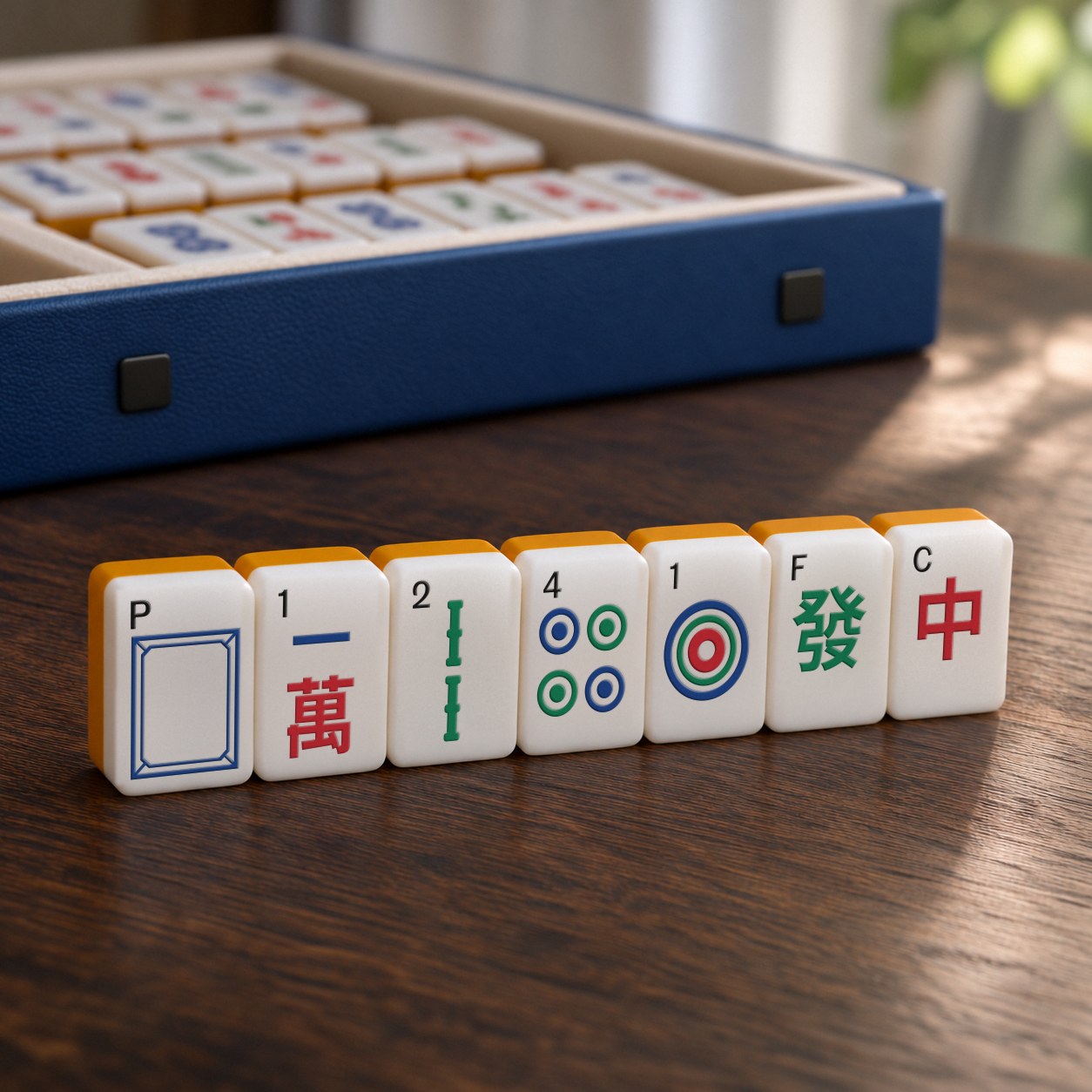 Pre-production image
168 tiles for six styles, with deep-engraved faces and a hand-finished illustrated case. £249, free UK delivery.
See the set