

I learned mahjong in my first winter at St Hugh's College, Oxford. A friend from Hong Kong came back after Michaelmas with his grandmother's set, a lacquered box wrapped in a scarf. One evening he untied it in the common room and taught three of us to play.
The tiles were yellowed and heavier than they looked, some worn so thin we had to tilt them to the lamp to read them. One 7 Dots had gone missing years before, so someone had drawn it on a blank in biro. Nobody minded. By midnight we knew the clatter of the shuffle. By the end of term we had a standing game.
Everyone brought their own rules.
That term taught me how the game travels. Somebody always teaches you, and their rules come with them. A friend from Penang wanted the animal tiles in. An American on exchange kept asking for the jokers. Someone else played the British rules he'd learned at home. None of them were wrong.
Mahjong took its modern form in nineteenth-century China. It went wherever its players went, to Hong Kong, Japan, Singapore and Malaysia. And in the 1920s to Britain and America. Each place settled on its own rules, and its own tiles.
Back in the cupboard.
Mahjong has come with me ever since. I've played in friends' rooms across England, hostels in eastern Europe and parlours across South East Asia. In time I taught my own family at home in London, and I was the one passing it on.
Each time, the set came out of a cupboard for the evening and went straight back in. I wanted one good enough to stay out on the table, one that says a game might start at any moment, and one I'd be proud to hand on.
What I kept, and what I changed.
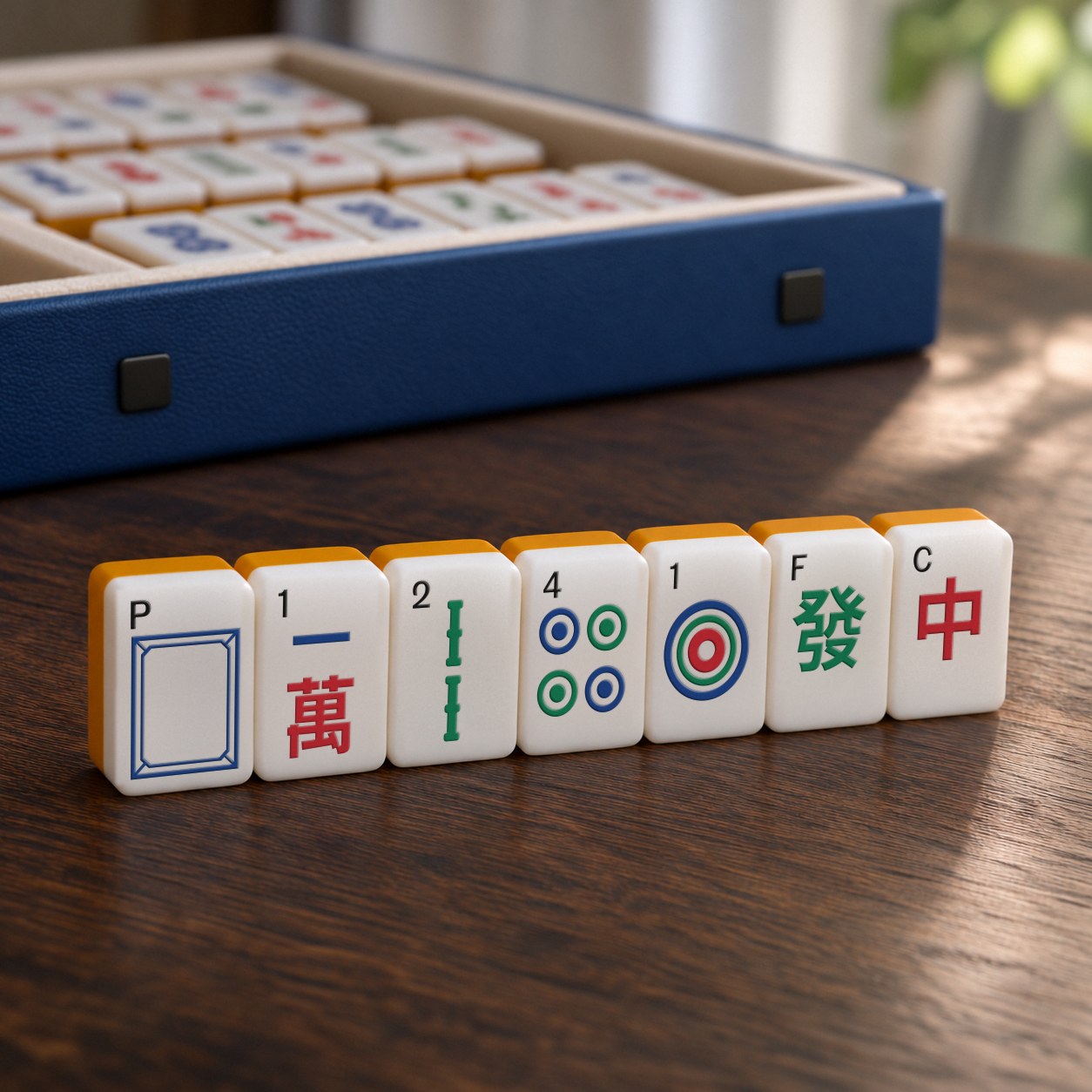 Pre-production image
The faces are the ones I was taught. The suits, winds and dragons are part of the game's history, and aren't ours to redesign. Virginia Chan, our heritage reviewer and a mahjong teacher in Hong Kong, checks every one before it's engraved.
The pictures are new. The sparrow across the lid is drawn for this set by Yennie Wong, a Hong Kong-born illustrator in London. She also draws the picture tiles inside, from the 1 Bamboo bird to the flowers, seasons, animals and joker. It's a sparrow because in Cantonese the game is 麻雀, the sparrow.
Then I went back to that first table.
- The worn faces we tilted to the lamp became deep-engraved, colour-filled faces on a matt surface. They're easy to read from every seat.
- Three friends with three sets of rules became every tile for six styles in one case, with the extras in a tray of their own.
- The biro 7 Dots became spares kept from every batch. Lose one under the sofa and, while your batch's spares last, an exact match is in the post within two working days.
- The cupboard became a deep blue illustrated case made to sit out between games.
The faces have a longer story. How mahjong tiles got their faces
 Pre-production image
Your turn.
Good Meld exists because people kept the game going and taught it on. Somebody taught you, or somebody is about to. One night you'll be the one shuffling the tiles and explaining a pung to someone who has never played. Send them First Hand first, and they'll arrive knowing how a turn works. If you're giving the set as a present, you're doing what my friend did in that common room, handing the game on. Either way, I hope this is the set on the table.
Mahjong, made to come together.
Ridwan Adam Ibrahim, founder
There's no office full of people. Email me at hello@goodmeld.com and I'll reply.