
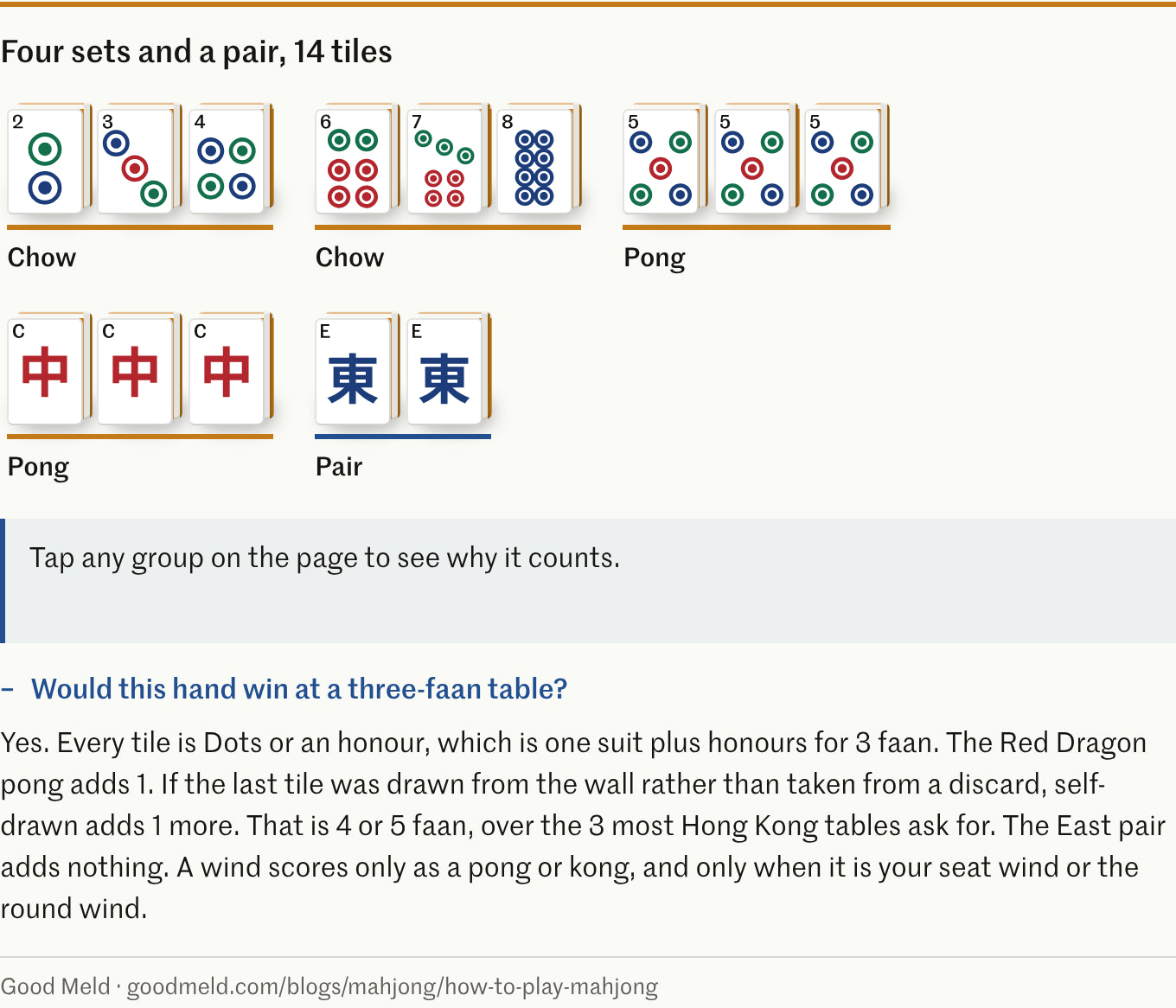
This is the shape you're aiming for in your first hand, four sets and a pair.
2, 3 and 4 of Dots, 6, 7 and 8 of Dots, three 5 of Dots, three Red Dragons and a pair of East winds.
Section 3 explains why each set counts.
Watch a turn (52 seconds) · Try a guided hand (about 8 minutes)
Teaching the table? Start with setting up, then follow the plan for your first evening.
| The game at a glance | |
|---|---|
| Players | 4 |
| Tiles | 144 in Hong Kong style |
| Tiles in your hand | 13, and 14 when you draw |
| A winning hand | Four sets of three and a pair |
| Your turn | Draw one tile, discard one |
| Minimum to win | 3 faan at most tables, none for a first game |
| One hand | 10 to 20 minutes |
| A full game | 4 rounds, at least 16 hands |
1. Which mahjong this teaches
There are at least six ways to play, and they share the same tiles and the same turn. Most London beginner classes start with Hong Kong style. Once you can play it, the other styles are a matter of what counts and how you score, not a new game. The rules here follow the Hong Kong Mahjong Association's rulebook. Where tables settle a point for themselves, we mark it as a house rule.
If your table plays another style, most of this guide still holds. This is what carries over and what changes.
| Your table plays | What carries over | What changes |
|---|---|---|
| American | The tiles, the draw and discard, pungs and kongs | Hands come from the yearly NMJL card, there are no chows, and jokers and the Charleston are added |
| British | The tiles, the turn, the calls and the winning shape | BMJA rules allow one chow in a hand, and scoring is in points and doubles |
| Singapore | The tiles, the turn, the calls and the winning shape | Four animal tiles join the flowers, and hands are valued in tai |
| Riichi | The tiles, the turn and the winning shape | No flowers, a hand needs at least one yaku, and a closed hand can declare riichi |
| Chinese Official | The tiles, the turn, the calls and the winning shape | A win needs 8 points from a fixed list of patterns |
First Hand asks which style you play and tells you the same thing at the end of the lesson. The house-rules card has a side on what each style uses and what tables usually agree.
2. The tiles
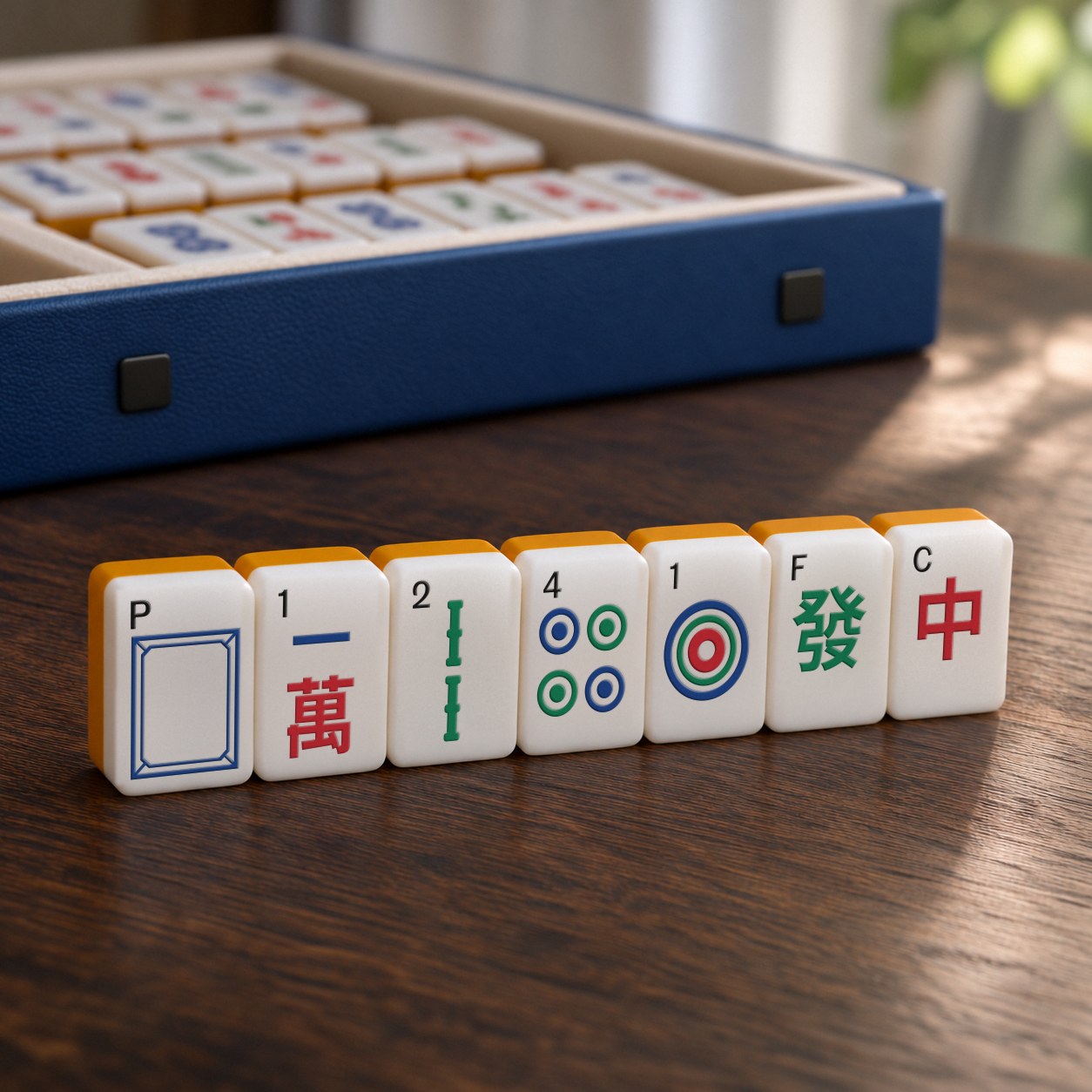
Hong Kong play uses 144 tiles. Three suits, two kinds of honour tile and eight bonus tiles.
| Group | What they are | Tiles |
|---|---|---|
| Dots | Circles, 1 to 9, four of each | 36 |
| Bamboo | Sticks, 1 to 9, four of each. The 1 Bamboo is drawn as a bird | 36 |
| Characters | A number in Chinese over the sign for ten thousand, 1 to 9, four of each | 36 |
| Winds | East, South, West, North, four of each | 16 |
| Dragons | Red, Green and White, four of each. The White Dragon is usually a blank tile with a frame | 12 |
| Flowers and seasons | Four flowers and four seasons, numbered 1 to 4. Bonus tiles, never part of a hand | 8 |
The suits run 1 to 9 and are the tiles you make runs from. Winds and dragons have no number, so they only ever come in matching groups. Flowers and seasons sit to one side, and at many home tables they score a little. Most sets print a small number or letter in the corner of the suit and wind tiles. Beginners should use them without shame. The patterns come with play.
The three suits picture money. Dots are coins, Bamboo is strings of coins and Characters are tens of thousands. The corner numbers came later, in 1920, for players who couldn’t read Chinese characters. How mahjong tiles got their faces tells the whole story.
3. The shape of a winning hand
A finished hand is 14 tiles arranged as four sets and a pair. That shape is the whole game. Everything else is the way you get there. Whether a finished hand is allowed to win also depends on what it scores, which is section 6.
- A chow is a run, three tiles of one suit in a row, such as 2, 3 and 4 of Dots. Only suits make chows.
- A pong is three of a kind, such as three West winds or three 7 Bamboo.
- The pair is two identical tiles. Players also call it the eyes.
- A kong is four identical tiles, counted as one set. A hand with a kong in it holds 15 tiles, not 14. So when you declare one, you draw a replacement tile to make up the number.
So a finished hand might be 2-3-4 Dots, 6-7-8 Dots, three 5 Dots, three Red Dragons and a pair of East winds. Tap each group below to see why it counts.
One hand to know about, because people will mention it, is Thirteen Orphans. One of each terminal (the 1s and 9s), one of each wind and dragon, and a pair of any of them. It breaks the four-sets rule and pays the limit. Nobody expects it in a first game.
4. Setting up
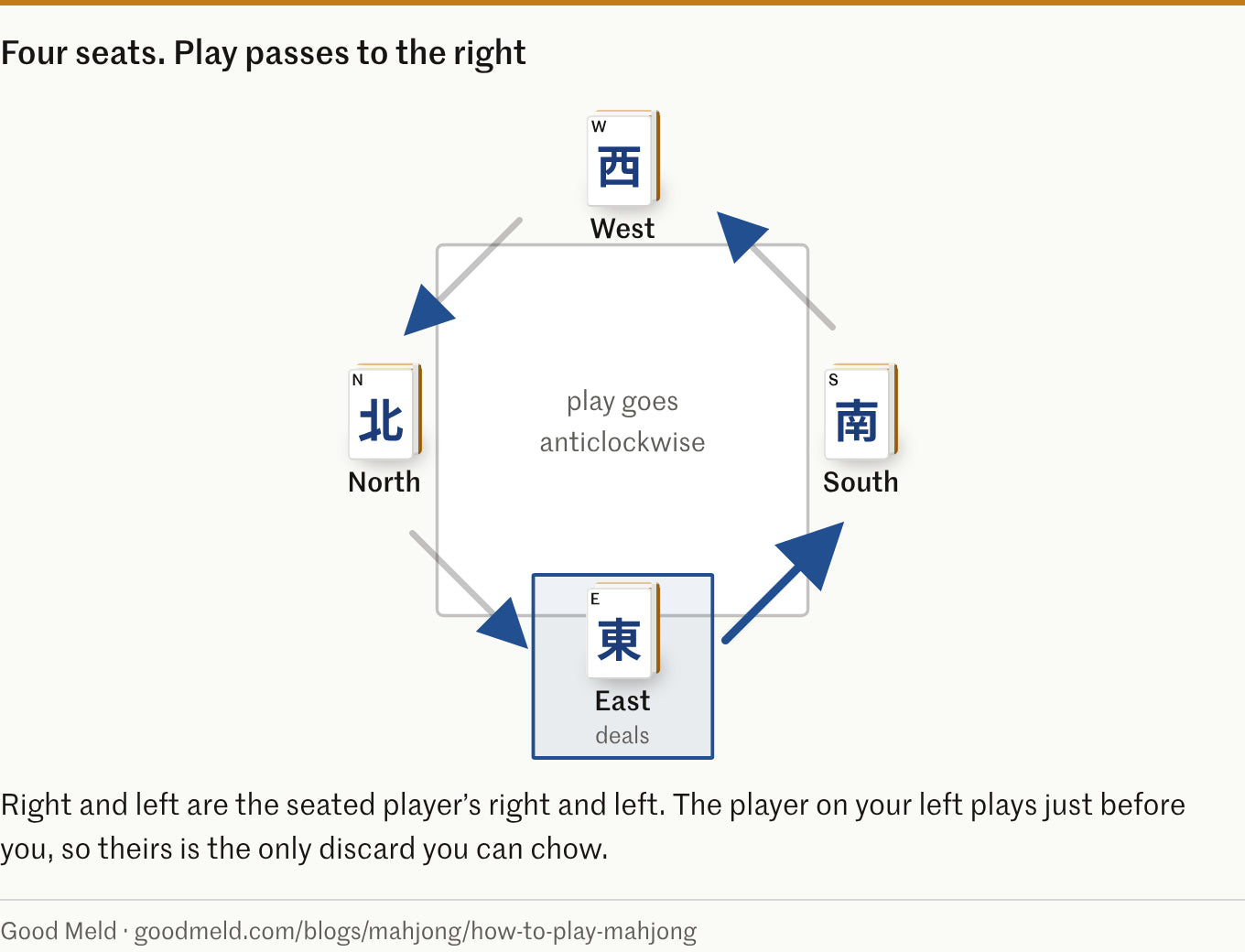
Seats. Four players sit round a square table. One is East for the first hand and deals. Draw a wind tile each or roll for it. The player on East's right is South, then West, then North, so the turn passes East, South, West, North and back to East. Seen from above that is anticlockwise. Right and left always mean the seated player's own right and left.
The wall. Turn all 144 tiles face down and shuffle them with your hands. Each player builds a row of 18 tiles, two high, in front of them, and the four rows are pushed together into a square. That is the wall, and it is where you draw from.
Breaking the wall. East rolls the dice (the Hong Kong Mahjong Association uses three). Count the total round the players anticlockwise, East as one, to find whose wall to open. On that player's wall, count the same number of stacks in from the right-hand end. Push the wall apart after that stack. Nothing is removed yet. Tiles are then taken from the left of the gap, working clockwise round the wall. Replacement tiles, for flowers and kongs, come from the other side of the gap, the tail. Step through it below.
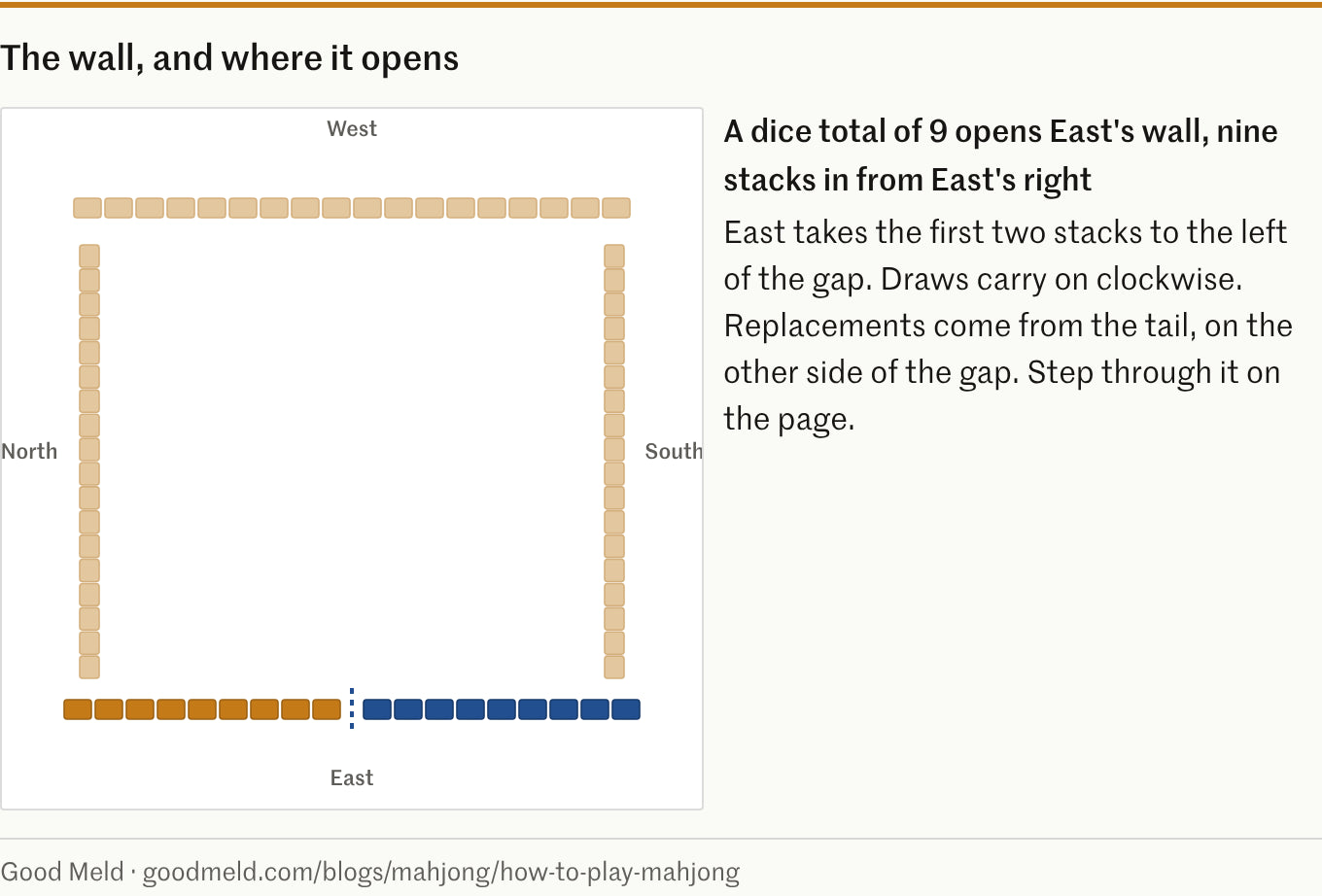
The deal. East takes the first two stacks, which is four tiles. South, West and North each take four, and so on round the table until everyone has 12. Each player then takes one more, and East takes a fourteenth. East starts the hand by discarding.
Flowers. Before play starts, anyone with a flower or season lays it face up beside their hand. They draw a replacement from the tail. Do the same whenever you draw one during the game.
Each player now holds 13 tiles, stood on edge facing them so the others can't see. For a first game, play one or two hands with everyone's tiles face up. Nobody learns anything from a hand they can't see.
5. A turn
Read the video as text
No narration and no music. Everything is on screen as captions, labels and movement. Quiet tile sounds play as tiles are picked up and put down. This transcript gives the on-screen words in order with what moves, so it also works as a text version of the lesson.
0:00 The Good Meld wordmark and "How a turn works. Hong Kong mahjong, in a minute." beside a table seen from above. You are East, at the bottom. South is on your right, West opposite, North on your left. Four discards lie face up in the middle.
0:03 You are East. Play passes to your right. (Blue arrows go round the table, East to South, West and North.)
0:05 Your turn. You hold 13 tiles. (Your hand: 2, 3, 4, 5, 5, 6, 7 and 9 of Dots, 1 of Characters, two East winds, two Red Dragons.)
0:07 Draw the next tile from the wall. (The next tile in the wall is outlined. It travels to the end of your hand. Sound: a tile picked up, then set down.)
0:10 Now you hold 14. (Label: 8 of Dots. It is sorted in beside the 6 and 7. Sound: a light tap.)
0:12 It completes a run, 6, 7, 8.
0:15 Discard one you don't need. (The 1 of Characters lifts and moves face up to the middle. Sound: the tile meets the table.)
0:18 Face up in the middle. Say its name. (Label: 1 of Characters. You hold 13 again. South's turn.)
0:21 South's turn. South draws. (The bottom tile of the same stack goes to South. Sound: a tile picked up, then a tap.)
0:24 South discards a Red Dragon. (The tile moves to the middle. Sound: the tile meets the table. Label: From South.)
0:27 You hold two Red Dragons. (Your two Red Dragons lift and are outlined.)
0:29 Pong. Optional. Any other player's discard. (Your turn. The Red Dragon moves from the middle to join your two. Sound: a tile set down, then three tiles laid down together.)
0:32 Lay the three face up. (Count: 11 in hand + 3 face up = 14.)
0:35 Discard without drawing. (The 9 of Dots moves to the middle. Sound: the tile meets the table. Count: 10 in hand + 3 face up = 13. South's turn.)
0:38 South is next. West and North are skipped.
0:42 In short. 1. Your turn. Draw one tile, discard one. 2. Someone discards a tile you hold two of. Call pong, lay the three face up, then discard without drawing.
0:47 Read the full guide. The wall, chow and winning a hand, step by step. goodmeld.com/how-to-play Illustration. Tile artwork in development.
On your turn you draw one tile from the wall and discard one tile face up in the middle. That's it. Your hand stays at 13 between turns. The discard is called out by name, which is how people keep up without staring at the table.
The interest is in the discards. When someone throws a tile you want, you can claim it instead of drawing.
- Pong. If you hold two of the discarded tile, call "pong", take it, and lay the three face up in front of you. Anyone at the table can pong, whatever the turn order.
- Chow. If the discard completes a run for you, call "chow" and lay the three face up. You can only chow from the player on your left, the one who plays just before you.
- Kong. Three in hand and the fourth is discarded, call "kong", lay four down and draw a replacement from the tail. You can also add a fourth to a pong you've already laid down, or declare four from your own hand.
- Win. If the discard completes your hand, call it, and the hand is over.
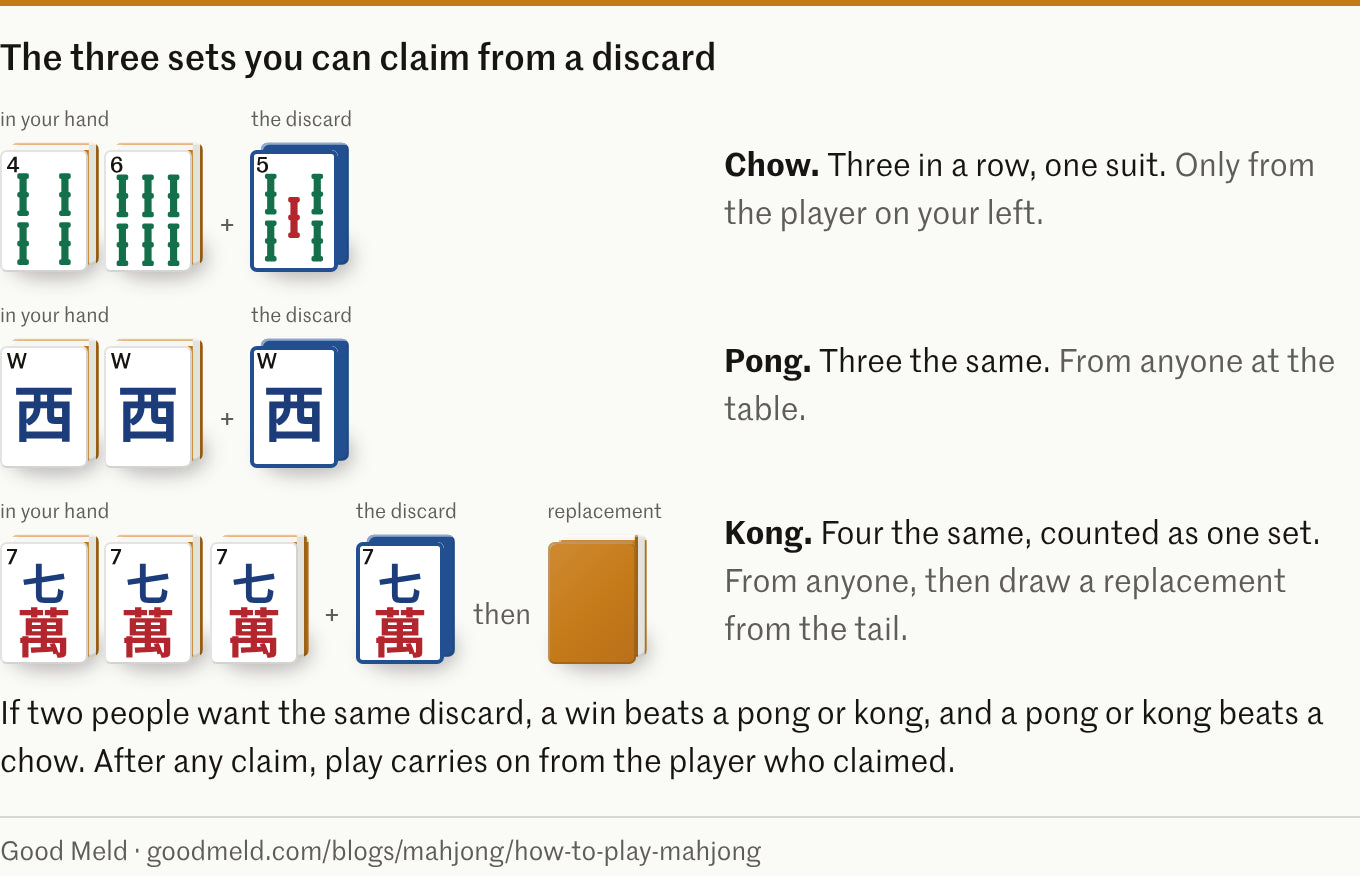
Two rules keep claims tidy. A win beats a pong or kong, and a pong or kong beats a chow. If two people want the same tile, the better claim takes it. And after any claim, play continues from the player who claimed, so turns can skip.
Sets you claim stay face up on the table for the rest of the hand. Sets you draw yourself stay hidden in your hand. In most styles a hand with nothing laid down is worth more. That's why strong players claim less than beginners expect.
Try a turn yourself in First Hand, a guided first game. About eight minutes, no rules to read first.
6. Winning, and the three-faan minimum
You can win on a tile you draw yourself, or on another player's discard. Either way you show the hand, the table checks it, and it is scored.
Hong Kong hands are valued in faan. Under the Hong Kong Mahjong Association's rules, as at most tables, you can't win on a hand worth less than three. That is the rule that catches beginners out, because the shape alone, four sets and a pair, is not enough. Faan come from patterns. These are the ones in the Association's list that a first-evening hand can realistically reach.
- All chows, no pongs. 1 faan.
- A closed hand, with nothing claimed from other players. 1 faan.
- Winning on a tile you drew yourself. 1 faan.
- A pong of any dragon. 1 faan each.
- A pong of your own seat wind, or of the round wind. 1 faan each, and 2 when your seat wind is also the round wind. A pair of winds scores nothing.
- Mixed one suit, meaning one suit plus winds or dragons. 3 faan.
- All pongs, no chows. 3 faan.
- Pure one suit, nothing but one suit. 7 faan.
Patterns add up, so a closed hand of all chows won on a tile you drew yourself is already three faan. A hand that scores nothing at all is called a chicken hand. Usually that means a mix of chows and pongs, with something claimed and no dragon or wind pong.
The Association gives nothing for flowers and seasons. Many home tables give 1 faan for having none, and 1 for each one that matches your seat. Agree it on your card. Tables set a limit too, 10 faan in the Association's rules and often 8 at home, so one lucky hand doesn't end the evening.
For a first game, agree a lower bar. Many teachers start with no minimum, so people get the feeling of finishing a hand. They raise it to three once everyone has won once.
7. Scoring and paying
Faan turn into points, and who pays depends on how the hand was won. Win on a discard and the player who threw the tile pays the whole amount. Draw the winning tile yourself and each of the other three pays half of it, so a self-drawn win brings in more. This is the Association's table.
| Faan | Won on a discard, the discarder pays | Self-drawn, each player pays |
|---|---|---|
| 3 | 32 | 16 |
| 4 | 64 | 32 |
| 5 | 96 | 48 |
| 6 | 128 | 64 |
| 7 | 192 | 96 |
| 8 | 256 | 128 |
| 9 | 384 | 192 |
| 10, the limit | 512 | 256 |
Many home tables use something simpler. Three faan is 8 points, and each extra faan doubles it. Some tables slow the doubling after four, which is the "half spicy" table on the house-rules card. Some also share a discard payment, so the discarder pays half and the other two split the rest. Some score faan for flowers, or stop at 8 faan instead of 10. Any of these works. Pick one before the wall goes up and write it on your card. Our First Hand game uses the Association's table.
Keep score with the sticks or chips in the set, or a pencil and paper. Nobody needs money on the table to enjoy this.
8. The next hand, and when the game ends
If East wins, East stays East and deals again. If anyone else wins, the deal passes to the right, and everyone's seat wind moves with it. If the wall runs out with no winner, the hand is a tie. Most home tables have East deal again, and some pass the deal anyway, so agree it on your card.
A full game is four rounds, named East, South, West and North, and each round lasts until all four players have dealt. That is at least 16 hands, which is three or four hours at a social pace. For a first evening, play the East round and stop. Four hands is enough to feel the game.
9. A plan for the first evening
If you can, have everyone play First Hand before the evening. It takes eight minutes each, and the table starts out already knowing the turn.
- Sort the tiles into their groups on the table and look at them together for five minutes. Name the suits, find the 1 Bamboo bird and the blank White Dragon, and set the flowers and seasons to one side.
- Deal one hand with everything face up and no claims. Just draw and discard, and say out loud what each person is trying to build. Stop when someone has four sets and a pair.
- Deal again, tiles hidden, claims allowed, no minimum faan. Call every discard by name.
- Once everyone has won a hand, bring in the three-faan minimum and keep score.
- Write what you agreed on a house-rules card and keep it with the set, so the next evening starts where this one ended.
Between game nights, Daily Meld is a daily puzzle to keep your mahjong sharp.
The words you'll hear
| Word | What it means |
|---|---|
| Chow | Three tiles of one suit in a row, such as 4, 5 and 6 of Bamboo |
| Pong | Three identical tiles |
| Kong | Four identical tiles, counted as one set |
| Eyes | The pair that finishes a hand |
| Honours | The winds and dragons |
| Terminals | The 1s and 9s of each suit |
| Faan | The unit a Hong Kong hand is valued in. The points table you agree before play turns faan into points |
| Sik wu | "Eat the hand", the Cantonese call for a win. Many tables just say "mahjong" |
| Self-drawn | Winning on a tile you drew from the wall, not a discard. Worth an extra faan |
| Chicken hand | A hand of four sets and a pair worth no faan at all |
| Tie | A hand where the wall runs out with no winner. Some tables say a wash-out |
| Tail | The far end of the wall, on the other side of the gap, where replacement tiles come from |
Questions people ask
Is mahjong hard to learn?
The turn takes a minute to learn and the winning shape takes a hand or two. What takes longer is reading the tiles quickly and knowing which patterns score. Both come with play, not study. Most groups are playing a real hand within an hour.
You can try a turn now in First Hand. Once you play, Daily Meld, our daily puzzle, sharpens how quickly you read a hand.
How long does a game of mahjong take?
One hand is about 10 to 20 minutes. A round of four hands is about an hour. The full four-round game is an afternoon or a long evening, which is why so many tables play a round and call it a game.
Do you need to know Chinese to play?
No. Each Characters tile carries a Chinese numeral, and there are nine to learn. With the corner numbers to help, beginners manage it in an evening. Everything else on the tiles is a pattern.
Can you play mahjong with two or three players?
Not without changing the game. There are versions for three and for two players. They drop some tiles and change the chow rule, and they're a reasonable way to practise. The game is built for four.
Is this the same as the mahjong on my phone?
No. The solitaire tile-matching game uses the same tiles and nothing else. The four-player game is the one people have played for about 150 years.
What do you need to play?
A set of 144 tiles or more, two or three dice, a square table about 75 to 90 cm across, and something to keep score with. Racks are for American play and most Hong Kong tables stand the tiles on the table. Our set has all 168 tiles for Hong Kong play and five other styles. It comes with scoring sticks and a guidebook with a set-up page for each. It opens for pre-order soon, and the list can pre-order 24 hours before anyone else.
Sources
- The Hong Kong Mahjong Association's Classical Mahjong rulebook, English edition dated 17 May 2023 (the three-faan minimum, the 10-faan limit, the list of faan and the points table, full payment by the discarder, three dice, replacements from the tail, a drawn hand called a tie), checked against the Hong Kong scoring rules on Wikipedia and Sloperama's mahjong FAQ.
 Pre-production image
168 tiles for six styles, with deep-engraved faces and a hand-finished illustrated case. £249, free UK delivery.
See the set